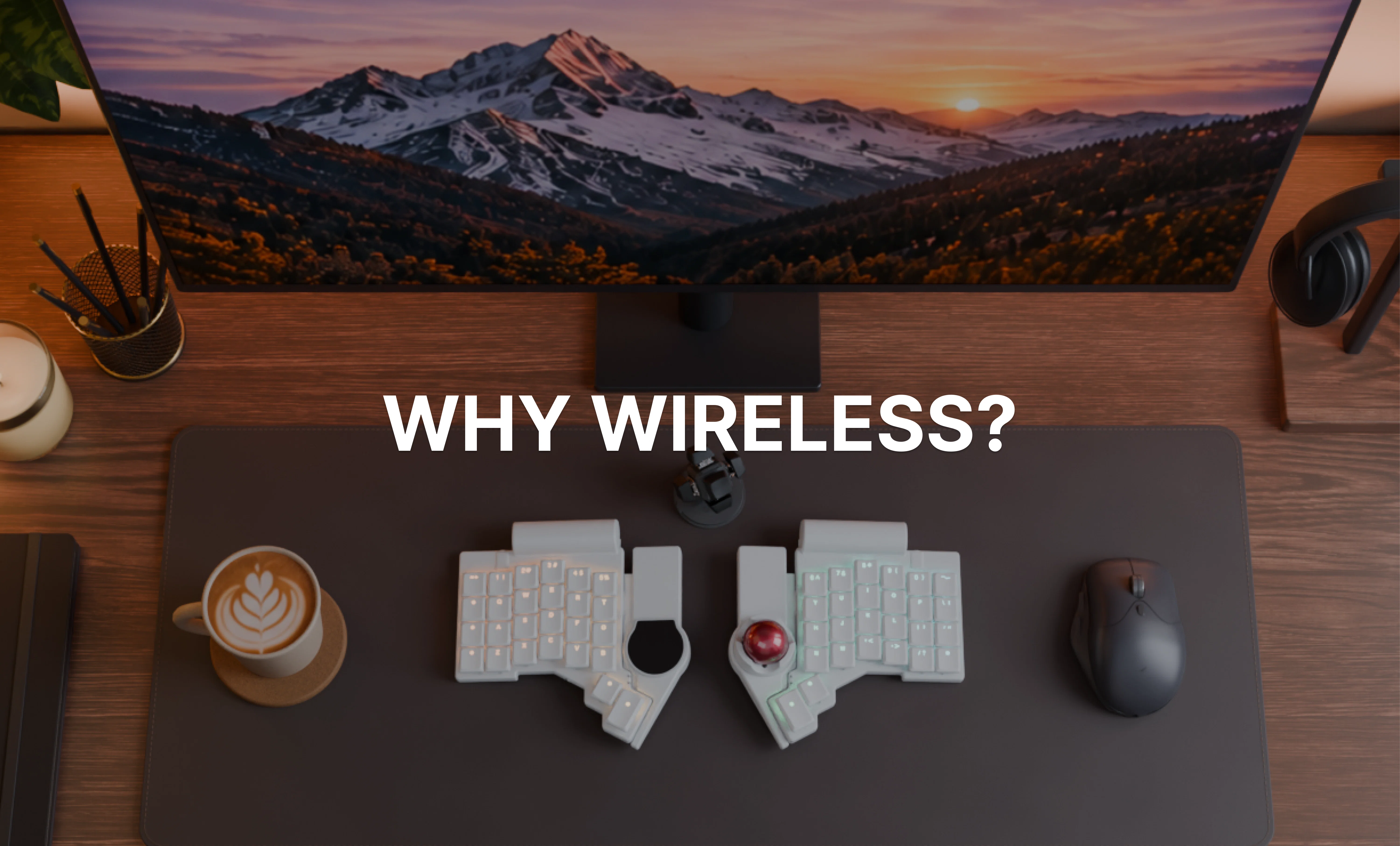
In the past, I said loudly and repeatedly that we will not be making a wireless keyboard. We made a whole page on the site about this. I really didn't want to do it. I think cables are great; they are simple and reliable. Many people just put their keyboard on their desk and park it there. Just run a short cable to your laptop and call it a day.
I felt fine about this, but the wireless idea wouldn't let me go. Or rather, you all wouldn't let it go. Customers kept emailing us every week asking for a wireless keyboard. This was clearly something many people were interested in, and I am always on the lookout for signs of overconfidence in my own thinking. Just because I felt strongly about wireless keyboards didn't mean I was right.
So we started teasing the problem apart and looking at the details. Why not make a wireless keyboard? Well, one big reason was the battery. Wireless keyboards use "pouch" lithium batteries, which are made in custom shapes to fit the enclosure tightly and are not standardized. So even if a battery is "replaceable", good luck getting that exact cell in ten years. You do get a nice slim-looking keyboard, but at the cost of generating e-waste when the custom pouch battery inevitably stops holding a charge. We were not going to do that.
So we needed a great rechargeable battery, but it had to be standard, something people could find anywhere in the world and actually replace without having to desolder anything. That was one requirement, which eventually led to us adopting 18650 cells. We found some beefy high-quality cells (Panasonic among others) to include with the board, but I also knew that people can get replacements in the future.
Another big thing was the firmware. Wireless split keyboards use ZMK. It was really built from the ground up for wireless keyboards. It's nice — but coming from the unbridled power of QMK, it felt a little limited. I did not want to give up QMK. I wanted our (first?) wireless keyboard to be more of everything, not to ask you to scale back your layout or firmware ambitions. ZMK is cool and we may go with it for a future board, but I wanted to start out strong with something that nobody's done before, a full split wireless keyboard powered by QMK.
The third big issue I had was around wireless performance and reliability. Is wireless actually reliable? In the past, it wasn't. But here I had to recalibrate my estimation: It turns out the nRF (Nordic) chips used in wireless split keyboards these days are really quite reliable. So we knew we had to use those chips.
Simple, right? Just find a good battery to use, use those reliable wireless chips, but still keep QMK. And to still keep QMK, we needed to keep the STM32 processor on the board. So where another keyboard would run on two nRF chips (one per side), we would run on two nRF chips and an additional ST chip on the left running QMK separately. And these three chips had to stay in sync the whole time, transition nicely between wired and wireless, and handle charging correctly.
The other thing to add here was, of course, our Navigator pointing devices. We made new enclosures ("shells") that snap onto the sides and make contact using pogo pins, so there are no cables to plug in. This had to work at runtime, without you having to shut the keyboard down. But we didn't want you to have to buy the new shell if you already own a Navigator, so we made sure it also works with the Voyager's existing shell, letting you plug the Navigator in via TRRS.
Speaking of TRRS, I didn't want to have a second USB-C port on the right side. To me, that felt clunky. So we figured out how to make the right side of the keyboard charge over TRRS, even when one or two Navigators are installed, whether they are connected through pogo or plugged in through the TRRS port.
If you're still with me by this point in the saga, you may be starting to see why this was the most ambitious (somewhat bonkers) technical keyboard challenge ZSA and Tibbo ever faced. There are lots of other details, including adventures with our all-new hard shell carrying case, but I will save those for a future podcast.
Bottom line: At one point I realized that making a split wireless keyboard that will address all of my concerns was not actually impossible — it was just very hard. So we did it.
Thank you for reading, and feel free to email us with any questions!