
Around wintertime, I find myself wanting to hunker down inside more often. I still like a good winter hike, brisk walk in the chill, or some winter sports despite the shorter days. But more often than not, I find myself wanting to cozy up with a good book, a favorite movie or TV-show rewatch, or to enjoy a feelgood video game. Perfectly timed for this year's "hibernation season" has been the game Lumines Arise.
Lumines is a block-puzzle game not too unlike the far better-known Tetris. Blocks of various patterns appear at the top of the screen, and it's the player's job to guide them down to the bottom of the screen, rotating them and positioning them left and right along the way. Rather than your goal being to build a full horizontal line of blocks like in Tetris, the aim in Lumines is to create 2x2 blocks of matching colors, which are then cleared off the screen in-time to the game's music by a sweeping "metronome timeline". If you're quick, you can drop several blocks and build an even bigger shape of the same color before that metronome sweeps through.
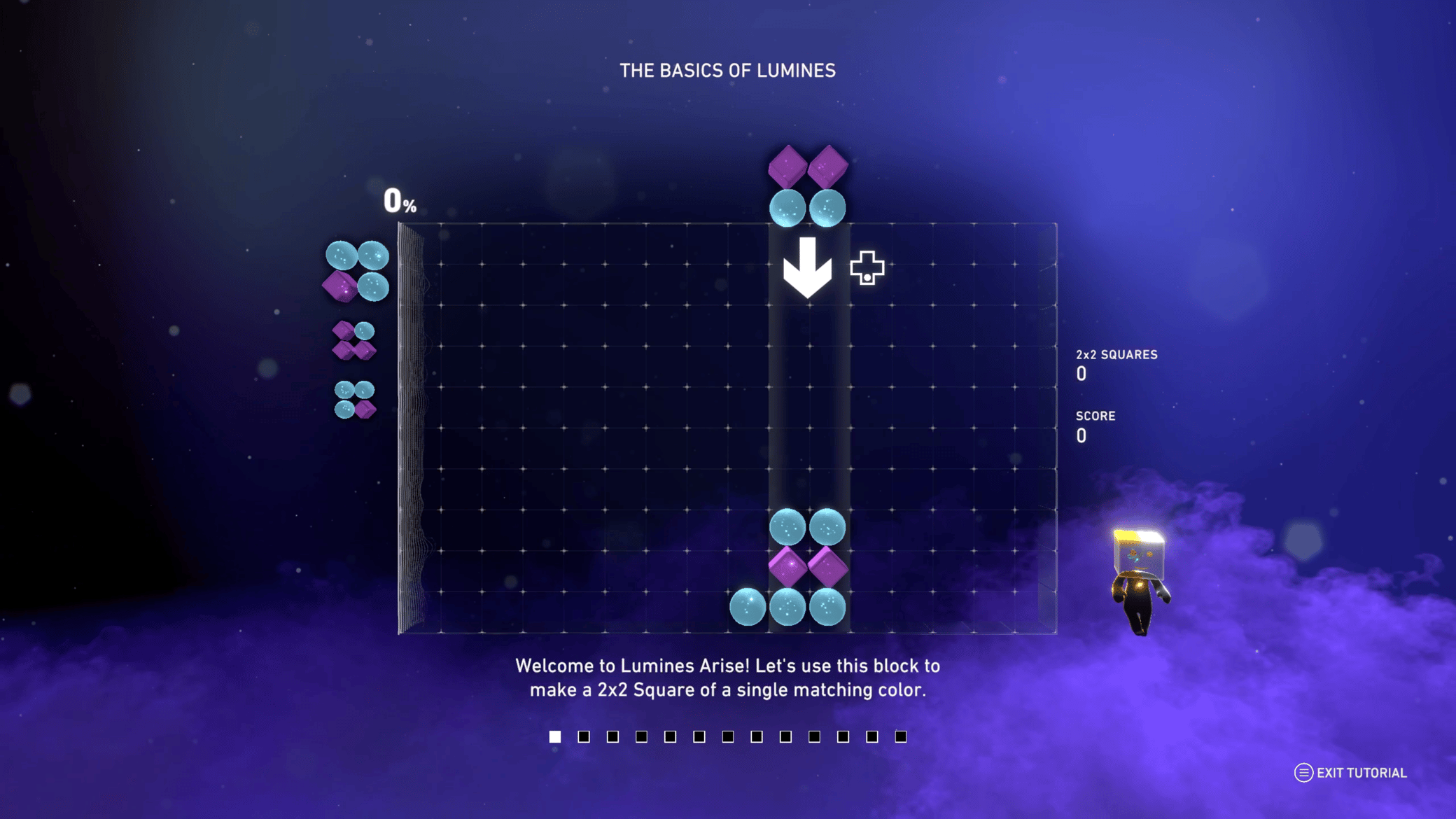
Arise just released late this fall as I'm writing this, and it's on both PlayStation 5 and Steam. So, you can play with either a controller or a keyboard, whichever's more comfortable for you. It's even possible to get the game running on macOS using something like Crossover or other Wine-based compatibility software.
Something maybe worth mentioning if you haven't tried a puzzle game in awhile (like if you've played Tetris on a Gameboy or other home-console awhile ago, but not since then), is that it can take a few failed "top outs" at first before you'll really get used to how patterns of blocks can be stacked together in order to clear. Feeling those little brain optimizations develop in real-time over the course of several attempts is neat; a satisfying, visual feedback loop as you improve.
Each time you rotate or move the blocks around, musical sound effects are fired off in time to your movements, adding sort of a "record scratch" or "dynamic sample" aspect to the game's soundtrack. Once you've cleared through a few dozen blocks, the game will transition to another set of visuals, sounds, and music. The experience is something I find it easy to be "swept away by".
Just to give an idea of the variety in store, here's the titular "Arise" level. It's a flashy opener with swelling music and some earnest background vocals:
Later on, there's also wackier designs like Slice & Dice and Chameleon Groove:
The game even skews towards UK-Drill style rap in Tropical Survival or subdued ASMR with Snowfall (and I do mean "skew" literally; some levels will dynamically tilt as you fill up the playfield with blocks):
Combining a block-dropping game with stylish visuals and music seems like a simple trick, but it's one the game's director, Tetsuya Mizuguchi, has been exploring and iterating on ever since 2004, when the first Lumines appeared as a launch title for the Sony PSP. I wish I could tell you I'm an OG fan, but my experiences with Lumines began much more recently during a Monster-Hunter-fueled PSP revisit in 2018. Since then, though, Lumines has been a mainstay for me on any platform I can get it on — a game I'll always keep installed as a "nice to have" even if it's not the cozy winter gaming season.
Digging into all the ways that Mizuguchi & co. have experimented in the direction of "gaming synesthesia" is unfortunately outside the scope of a post like this. To put it personally, though, both the specially-musical Tetris Effect from 2018 and now Lumines Arise are much more than just video games to me. Their combination of gameplay and responsive sights and sounds have become treasured experiences to come back and delight in.
Not to get too hand-wavey, but there's definitely something to that. A friend of mine who tried Lumines for the first time recently described it as "cerebral" — and I think that's a great word for how it feels to settle into a playsession. The player's brain gets to singularly focus on placing blocks and forming combos, while the music, sound effects, and other accoutrement sort of fly on by.
Some people do lean pretty hard into this, either through the game's VR headset support or through the dev company's custom designed "Synesthesia suit" project, a special installation that they brought to a few gaming trade shows. I can't speak to all of that, but I do think there's something focus-inducing and brain-tingling enough to be described as a sort of "video game zen". Everyone's different, though — how this sort of thing feels for your own brain, you'd just have to see for yourself.
The Surprise
Even though I'd played the older versions of Lumines, I'd never paid much mind to the scoring or online modes. I don't generally search out competitive aspects in video games, so I was impressed when some of Lumines Arise's online offerings became new favorite ways to play.
The game's "multiplayer" lobby has a whole host of challenge modes and leaderboards to try your hand at, as well as a head-to-head versus mode. The daily "Quick Burst" challenge caught my attention early on as a way to freely practice Arise's new "burst" combo mechanic. This has you building a shape of a single color as large as possible over several timeline sweeps (rather than it being cleared away in a single sweep like usual). The mechanic can be a little tricky to get used to, though, especially during a more normal playsession. Quick Burst being a self-contained sandbox for that trickier mechanic made a big difference for me, and I spent several hours experimenting with different ways to execute a successful burst.
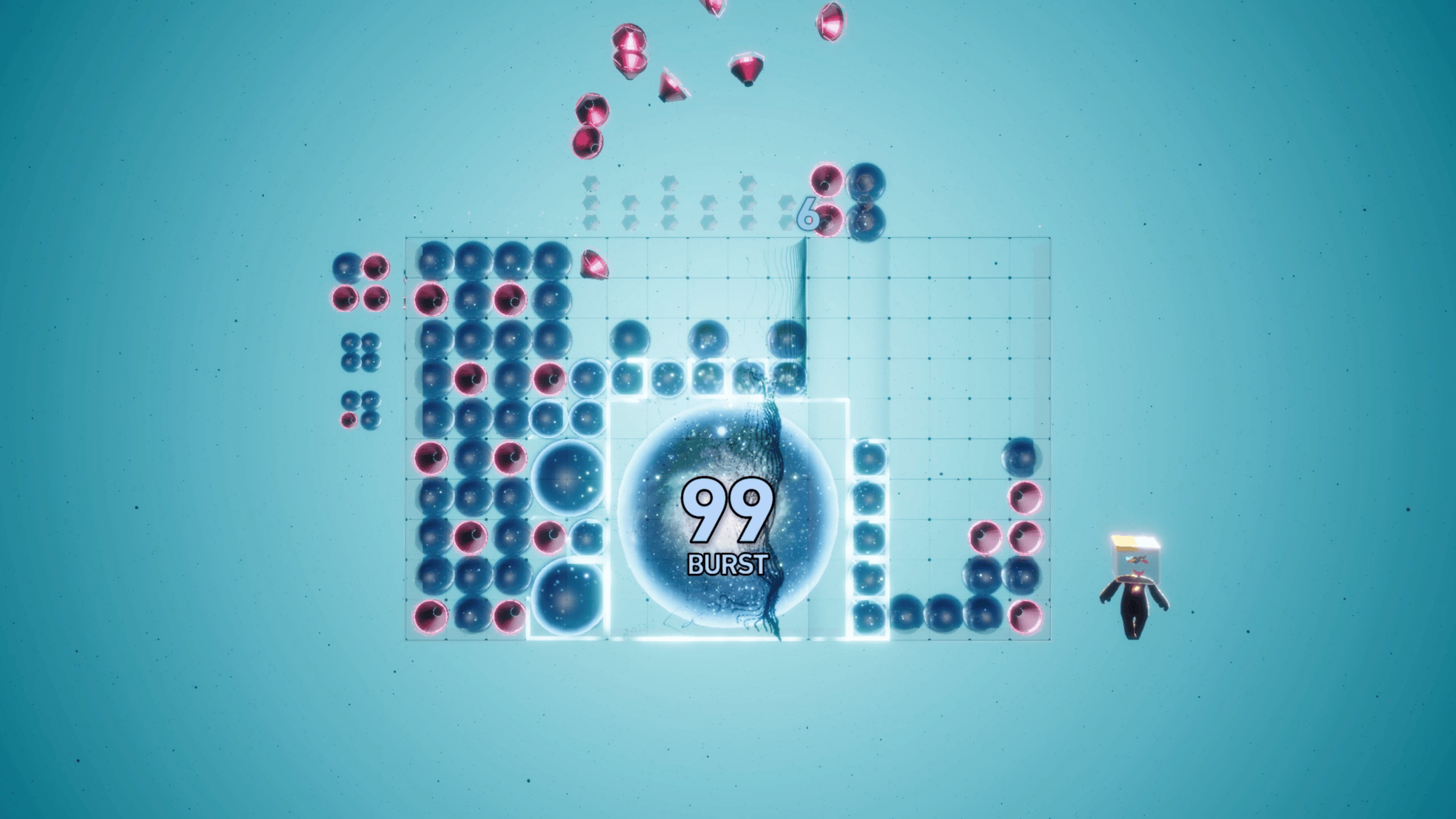
Even now that I'm more comfortable with how burst works, I still come back often and try my hand at getting the largest burst combo that I can each day. Quick Burst changes to a different one of the game's visual "levels" every 24 hours, and there's a top 10 leaderboard that resets daily along with it. That's just short enough a time period for a less-serious player like me to occasionally see my name up towards the top. Even if I'm knocked out of the top 10 as more players lodge a score for the day, it still feels satisfying!
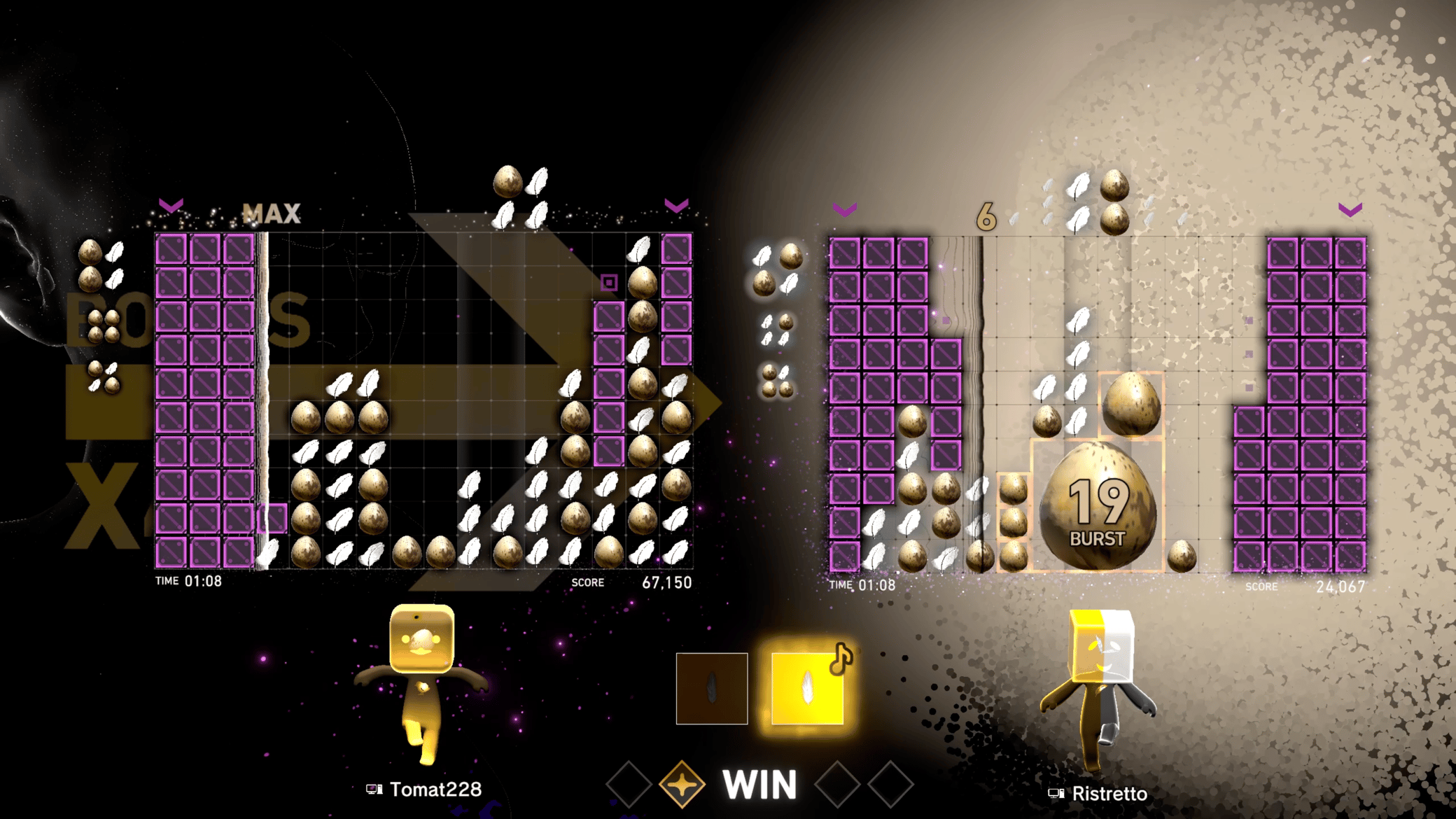
Apart from the leaderboard, it was surprisingly enjoyable to apply that practice to 1-on-1 "Burst Battle" matches. In these, your stacking and matching of blocks sends "garbage" to the opposing player's board, with the match continuing until someone runs out of space and tops out. I lose these matches as often as I win them (if not more), but the enjoyment of the game itself and the quickness of the rounds means it doesn't feel too stressful or involved to try.
Lumines feels like a unique mixture of a game. One that melds simple, fast gameplay that you can gradually improve at with always-shifting artistic music and visuals. Many other games have these parts, but few knit them together in a way that tickles quite so far down my brainstem.